New York
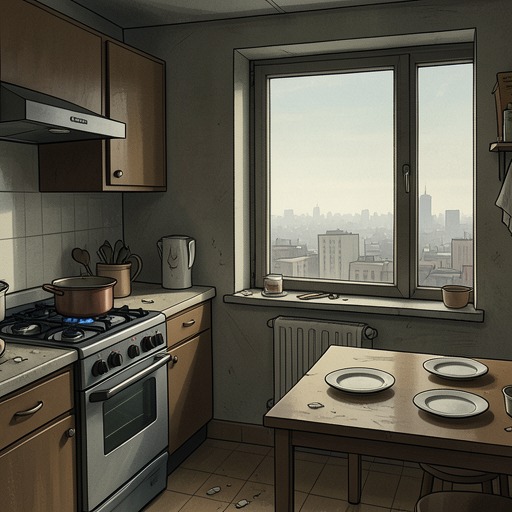
Earth AbidesNew York is the city Ish unconsciously seeks because he regards it as the center of the American world: if the catastrophe has transformed New York, he reasons, its consequences must reach everywhere. Manhattan’s silent streets and abandoned landmarks confront that expectation with a city still standing but emptied of ordinary life. Its durable structures will endure for a time, yet the people who once animated them are gone or hidden, and nature and weather have begun their gradual work on the built landscape.
Approach and Meaning
Ish reaches New Jersey after crossing the Delaware River and arrives at the Pulaski Skyway around noon. The route recalls a trip he made there at fifteen with his parents. Then, the converging traffic had frightened him; his father watched the signs anxiously while his mother offered nervous advice. Now Princess sleeps beside him on the front seat, and Ish speeds across the Skyway alone. The contrast makes the journey a measure of the change: a once-busy approach to the metropolis has become an empty road traveled by one survivor and his dog.
The distant skyscrapers stir a recognition Ish had not fully understood before. New York is, in his mind, the center of the world for Americans, and its fate offers a measure of what may have happened elsewhere. Yet the approach no longer sounds or behaves like a working city. At the cloverleaf above Jersey City, Ish stops in the roadway to read the signs without provoking horns, complaints, or police intervention. He hears a bird and the faint murmur of his idling engine. Uneasy about entering tunnels that may have filled with water and trapped him, he turns north and crosses the empty George Washington Bridge into Manhattan.
Empty Streets and Familiar Routes
Once in Manhattan, Ish drives south on Broadway, intending to reach the Battery. At 170th Street, a Street Closed sign directs him east. He chooses to obey it, turning onto Amsterdam Avenue before heading south again. He interprets the detour as a precaution around the Medical Center, which he suspects had been one of the city’s last places where people gathered. Even the remaining signs of official direction now function without the officials who would once have enforced them.
Amsterdam Avenue is vacant. Ish considers how the disease may have struck the densely populated island especially hard, and wonders whether what he calls the Secondary Kill would also have been more severe in a wholly urban population. He knows that some people survived elsewhere and thinks Manhattan’s millions must have included survivors, but he no longer considers a few isolated stragglers worth announcing himself to. His passage therefore differs from a search for contact: the possibility of survivors remains, but he does not sound his horn or interrupt the quiet to find them.
He continues block after block through a city without movement. Though the clouds have cleared and the sun stands high, the empty sidewalks evoke a depth of abandonment beyond an ordinary deserted Sunday. A few cars remain parked along the curbs, and he remembers his father taking him through downtown when even Wall Street was empty. That earlier emptiness had been temporary and familiar; Manhattan now resembles it only in appearance, while its absence of people has become the condition of the city.
Landmarks and Signs of Ruin
Near the southern end of his drive, Ish sees the Statue of Liberty and reflects ironically on the freedom it represents: in the deserted city, it is one of the few inheritances he feels he still possesses. The landmark remains visible, but its meaning has shifted from a public emblem to a private measure of what the survivor has been left with.
Near Governor’s Island, a large liner lies aground at a steep angle, stranded by the falling tide. Ish imagines that infection had spread aboard before the ship left Europe and that the dying crew reached a port that had stopped sending signals. No tugs came out to meet it. The liner’s position turns the harbor into evidence of a wider breakdown: even the ordinary communication and rescue that connect a port to arriving vessels have failed. Ish also envisages a much longer future for the wreck, as waves lay mud against it and trees eventually grow around a rusted hull that may become difficult to distinguish from a small island.
A City Outlasting Its Inhabitants
The narrative gives New York a future measured in slow material changes rather than human activity. Between its rivers, Manhattan’s stone, brick, concrete, asphalt, and glass can withstand weather for a long time. But survival of the structures is not permanence: loose windowpanes break, lightning dislodges cornice tiles, rain weakens walls, and frost scales stone. Gutters and storm drains continue to direct water toward the rivers, while snow gathers undisturbed in the street canyons and melts with the spring thaw. The city persists, but its maintenance has ceased; gradual weathering replaces the continuous labor that had kept its surfaces intact.
Ish’s route through the East Side brings him past Bellevue Hospital, and he encounters similar difficulty around Pennsylvania Station and the adjoining hotels. He turns north on Eleventh Avenue, then onto Riverside Drive as the sun lowers over the smokeless smokestacks on the Jersey shore. There, wondering where to spend the night, he hears someone call to him. Princess barks furiously as Ish stops and sees a man emerge from an apartment-house entrance; Ish leaves her in the car and goes to meet him. The encounter marks a consequential change in his New York passage: after moving through a metropolis that had seemed wholly empty, he is at last answered by another person. The city has not restored its former life, but it has not been entirely without survivors.